The Memento pattern
The Memento Design Pattern
🔐 Overview
The Memento pattern is a behavioral design pattern that allows capturing and storing an object’s internal state without violating encapsulation, making it possible to restore the object to this state later.
🧭 Contents
- Understanding the Pattern
- Implementation Guide
- Common Use Cases
- Best Practices
🔄 Understanding the Pattern
The Memento pattern provides a way to store a snapshot of an object’s internal state. This pattern is particularly useful when you need to implement undo mechanisms or maintain history states of an object.
🛠️ Implementation Guide
The pattern consists of three key components:
- Originator: The object whose state we want to save
- Memento: Stores the internal state of the Originator
-
Caretaker: Manages and safeguards the Memento
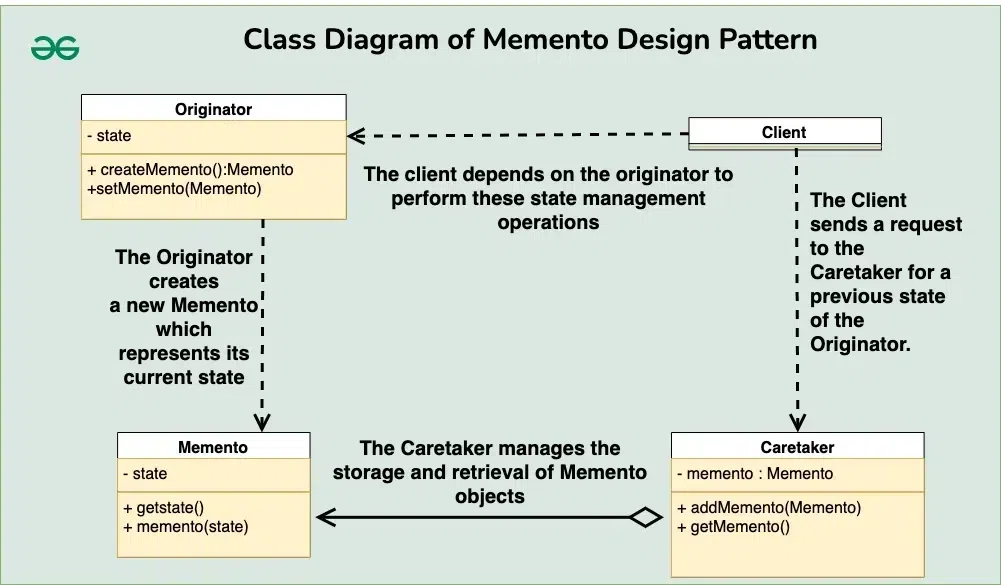
Here’s a basic implementation example in Java:
Basic implementation of the Originator class that maintains state snapshots T represents the type of state to store (e.g., String, byte[], etc.) U represents the type of state updates (e.g., String, byte[], etc.)
public abstract class Originator<T, U> {
    protected T currentStateSnapshot;

    public void write(U stateUpdate) {
        updateState(stateUpdate);
    }

    public Memento<T> createStateSnapshoot() {
        Memento<T> memento = new Memento<>(this.currentStateSnapshot);
        this.currentStateSnapshot = null;
        return memento;
    }

    public T getStateSnapshoot(Memento<T> memento) {
        return memento.getSnapshot();
    }

    /**
     * Updates the current state snapshot based on the provided state update.
     * Implementing classes should define how state updates are applied to the current state.
     *
     * @param stateUpdate The incremental update to be applied to the current state
     * @throws IllegalArgumentException if the state update is invalid or incompatible
     */
    protected abstract void updateState(U stateUpdate) throws IllegalArgumentException;

}
This code demonstrates the core Originator class which is responsible for:
- Maintaining the current state
- Creating state snapshots (mementos)
- Restoring state from mementos
- Processing state updates via the abstract updateState method
The Memento class is a simple container for storing state snapshots It uses generics to work with any state type T
public class Memento<T> {
   private T snapshot;

    public Memento(T snapshot) {
        this.snapshot = snapshot;
    }

    public T getSnapshot() {
        return snapshot;
    }

    public void setSnapshot(T snapshot) {
        this.snapshot = snapshot;
    }
}
A small observation: Consider making this class immutable by removing setSnapshot() and making snapshot final if state should not change after creation
The Caretaker class is responsible for managing the history of object states in the Memento pattern. It acts as a storage facility that maintains a collection of Memento objects, allowing for:
- Saving new state snapshots
- Restoring previous states in a LIFO (last-in-first-out) manner
- Maintaining the history of state changes
public class Caretaker {
    private List<Memento> history;

    public Caretaker() {
        history = new ArrayList<>();
    }

    public void save(Memento memento) {
        history.add(memento);
    }

    public Memento restore() {
        if(history.isEmpty())
            return null;

        return history.remove(history.size() - 1);
    }

    public long size() {
        return history.size();
    }
}
The Caretaker has no knowledge of the internal structure of the Memento objects it stores, preserving encapsulation while enabling state restoration functionality.
Example
Here you can find an example that uses the memento pattern.
🚀 Common Use Cases
The Memento pattern is widely used in various scenarios including:
1. Undo/Redo Operations
- Text editors storing text states
- Graphics editors saving image states
- Version control systems
2. Transaction Management
- Database transactions
- Multi-step form submissions
- Shopping cart checkouts
3. State Management
- Game save states
- Application checkpoints
- Configuration snapshots
4. Data Recovery
- Auto-save functionality
- System restore points
- Crash recovery mechanisms
5. Workflow Applications
- Business process states
- Multi-stage wizards
- Progress tracking systems
🎯 Best Practices
- Keep Mementos Immutable
- Once created, a memento’s state should not be modifiable
- This ensures data integrity and prevents accidental state corruption
- Consider Memory Usage
- Store only essential state information in mementos
- Implement cleanup mechanisms for old/unused mementos
- Use shallow copies when possible unless deep copies are required
- Protect the Memento’s State
- Restrict access to memento data
- Only the originator should be able to access/modify memento contents
- Use private inner classes or encapsulation
- Handle Serialization Properly
- If mementos need to persist between sessions, implement proper serialization
- Consider security implications when serializing state data
- Validate data when deserializing
- Document State Contents
- Clearly document what state information is stored in mementos
- Include versioning if state structure might change
- Add timestamps or metadata when relevant
- Error Handling
- Implement proper error handling for state restoration failures
- Add validation to ensure state consistency
- Consider using the null object pattern for invalid states
- Performance Considerations
- Use lazy loading for large state objects
- Implement state compression for memory efficiency
- Consider using flyweight pattern for shared state